Modified Shipping Containers UAE: 6 Applications and What Each One Requires
- Momentum Containers
- Jul 14
- 5 min read
Updated: Aug 8

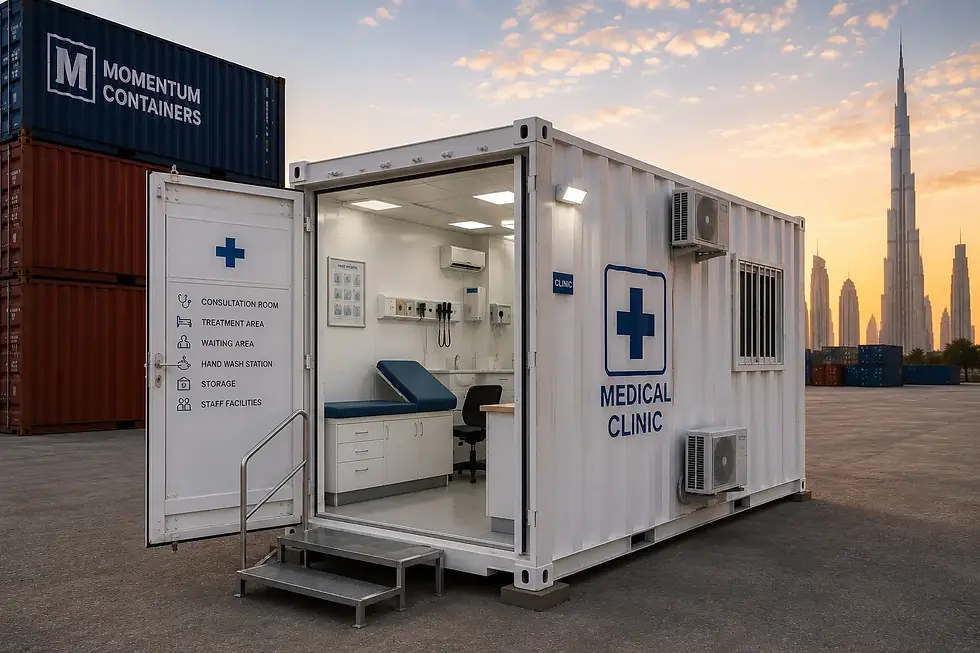
A standard ISO shipping container is a steel box. It stores cargo, stacks on vessels, and moves through ports. That is what it was designed to do. A modified shipping container in the UAE is something different, it is the same steel box after it has been structurally changed, fitted out, and prepared for a specific use on a specific site.
The modification changes everything. Openings are cut for windows and doors. Insulation goes in 50mm polyurethane panels on all four walls, the ceiling, and the floor. Electrical wiring, AC units, plumbing, internal cladding, and flooring follow. The result is a structure that sets up in hours, passes regulatory inspection, and works in UAE summer conditions where outdoor temperatures exceed 45°C for months at a time.
Modified shipping containers in UAE are now used across construction, oil and gas, food service, healthcare, retail, and hospitality. The UAE modular construction market is valued at USD 1.6 billion in 2026. That number reflects real demand from project managers and procurement teams who have run the numbers and chosen containers over conventional construction for cost, speed, and flexibility reasons.
At Momentum Containers, we fabricate modified containers at our yard at Sharjah Inland Container Depot (SICD), off Emirates Road (E611). Every unit is built to specification, inspected, and documented before it leaves our gate.
Container Modification in UAE: The Six Most Common Applications
Container modification in UAE covers a wide range of finished products. The application determines the specification, the regulatory pathway, and the cost. These are the six most common uses across Dubai, Abu Dhabi, Sharjah, and the Northern Emirates.
Site offices and security cabins:
The most common modified container application across UAE construction sites. A 20ft site office on a project along Sheikh Mohammed Bin Zayed Road (E311) or near ICAD Mussafah in Abu Dhabi needs 50mm PU insulation, a 1.5-ton split AC, epoxy flooring, aluminum-framed windows, and basic electrical fit-out. A 10ft security cabin adds a full-width sliding glass window for gate sightline coverage. Both set up without any civil works and relocate on a flatbed truck when the project moves.
If you want to understand what the full conversion process looks like from brief to delivery, our article on container conversions Dubai covers every step from structural assessment to final inspection and documentation.
Worker accommodation:
Construction and infrastructure contractors managing long-duration projects at Dubai Industrial City, Jebel Ali Free Zone, and along the Abu Dhabi-Al Ain Road (E22) use modified 20ft containers as four-person dormitory units. Each unit carries steel bunk frames, lockable under-bunk storage, a 2.0-ton split AC, and industrial vinyl flooring. The 50mm PU insulation keeps internal temperatures below 28°C even when outdoor air hits 45°C.
Offshore and oil and gas units:
Container modification in UAE for offshore applications follows a stricter specification than onshore builds. Units going to platforms in the Lower Zakum field or to Ruwais Industrial Complex need hot-dip galvanised exteriors, rock wool insulation for fire resistance, 24V hazardous-zone rated lighting, and DNV 2.7-1 certified lifting lugs. ADNOC HSE documentation travels with every unit. For a full breakdown of offshore container specifications and what ADNOC compliance involves on UAE energy projects, visit our offshore containers service page.
Commercial kitchens:
Modified shipping containers for food service need 1.2mm marine-grade stainless steel interior cladding on all surfaces, LPG single-phase gas systems with automatic solenoid shut-off, 1,200mm extraction hoods, and non-slip ceramic tile flooring, all to Dubai Municipality food code requirements. High-cube containers are the preferred base because the extra 300mm of internal height allows a full extraction hood to fit without cutting through the roof.
Sanitation and welfare blocks:
Self-contained toilet facilities with built-in 2,000-litre GRP septic tanks are a standard modified container product for construction sites in remote areas of Ras Al Khaimah, Fujairah, and Abu Dhabi where no municipal drainage connection is available. The entire waste system, toilets, plumbing, treatment, and discharge, operates from inside one 20ft container. The only external connection required is a standard 1-inch BSP fresh water inlet.
Specialty conversions:
Water treatment plants inside 20ft ISO units, containerized electrical switch rooms, rooftop padel tennis courts built on high-cube container platforms, and branded exhibition units for trade events at Expo Centre Sharjah on Al Taawun Street, these are all modified shipping container applications that exist and operate across the UAE right now.
Shipping Container Conversions: What Sets a Good Build Apart From a Bad One
Not all shipping container conversions in UAE are built to the same standard. The difference between a unit that passes Dubai Municipality inspection on first submission and one that fails comes down to decisions made at the fabrication stage.
Insulation specification:
UAE summer conditions demand 50mm polyurethane panels as a minimum. A container insulated to temperate-climate standards will not hold temperature in a Dubai July. The AC works harder, electricity costs rise, and the interior becomes uncomfortable within hours of the system cycling off. Dubai Municipality's R-15 minimum thermal standard exists for exactly this reason.
Structural reinforcement at cut openings:
Every window and door opening cut into a container wall weakens the structural integrity of that panel. A properly built conversion adds steel box section frames around every opening to restore the load path. A poorly built one does not and the container begins to rack and deform under its own weight over time, especially when stacked or crane-lifted.
Compliance documentation:
A modified container without a CSC plate, condition report, and application-specific certification will not pass ADNOC site access, Dubai Municipality permit review, or Civil Defence inspection. The paperwork is not optional it is what allows the unit to go where you need it to go.
How to Order a Modified Container in the UAE
The process is straightforward when you work with a fabricator who has in-house capability and does not outsource the build.
Step 1 — Brief: Tell us the application, the site location, the required certifications, and the delivery date. We confirm what is achievable and what the specification needs to be.
Step 2 — Specification: We prepare a full build specification, insulation type and thickness, electrical layout, mechanical systems, interior finishes, exterior paint, and documentation requirements. For complex applications, offshore builds, commercial kitchens, and multi-container complexes, we include structural drawings.
Step 3 — Fabrication: The build happens at our SICD yard in Sharjah. Our team handles all welding, insulation, electrical, plumbing, and finishing work in-house. No subcontracting.
Step 4 — Inspection and documentation: Every unit goes through a pre-delivery inspection at our yard. Condition report, CSC plate check, and any application-specific certification are issued before dispatch.
Step 5 — Delivery: We deliver on flatbed trucks from SICD Sharjah. Dubai sites receive delivery in 45 minutes. Abu Dhabi in 90 minutes. RAK in under 3 hours.
For a same-day quote on your specific application, contact our team through our container conversions service page.


Comments